
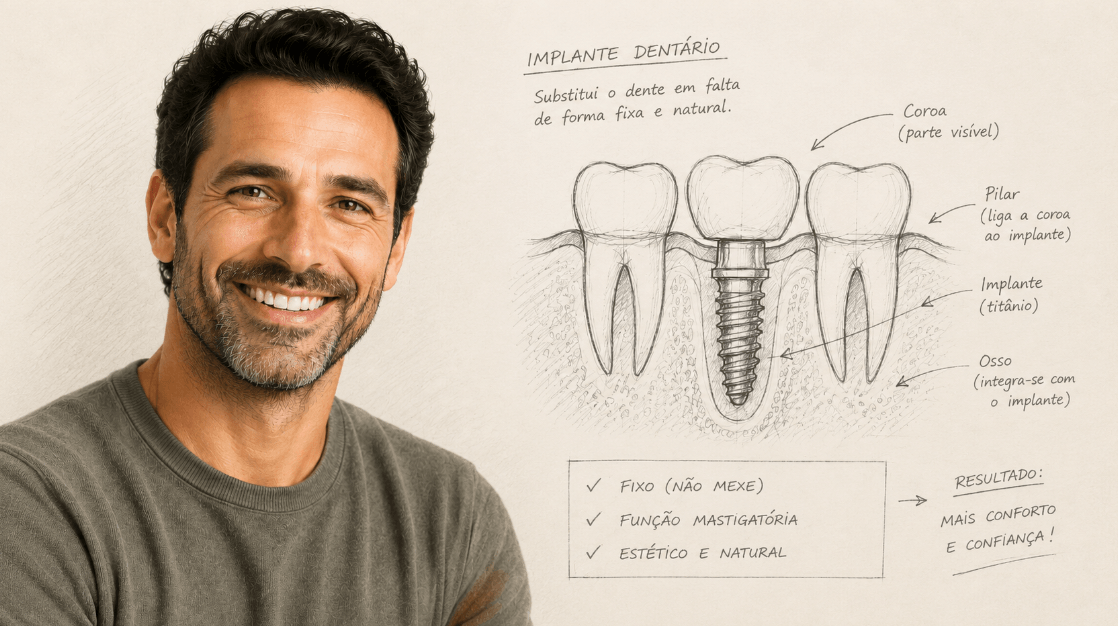
Losing a tooth can happen at age 25, 45, or 65. The important thing is to realise why you should replace it as soon as possible.
1. Lost a tooth? Why replacing it early matters.
When you lose a tooth, it’s natural to think that the problem is purely cosmetic. If the gap isn’t very noticeable, many people adapt quickly. They learn to chew on one side, avoid certain foods and get used to their new smile. But what isn’t immediately apparent is what happens in the months and years that follow.
2. What happens when a missing tooth is not replaced?
Teeth do not exist in isolation. Each one plays an important role in the balance of the mouth. When one of them is lost, that whole balance gradually begins to shift.
Neighbouring teeth tend to tilt towards the space. The tooth in the opposite arch may start to shift. The way we chew changes. In some cases, difficulties with oral hygiene, excessive wear on certain teeth or problems with the jaw joint may arise.
There is also a lesser-known consequence: bone loss. The bone that supports the teeth needs stimulation to remain healthy. When a tooth is lost and not replaced, the bone in that area slowly begins to lose volume. Over time, this loss can make any future restoration more complex.
This is why what often starts as a seemingly minor problem can end up requiring more complex treatment than initially expected.
Single-tooth implants are the solution that most closely resembles a natural tooth. They have been developed specifically to replace a single missing tooth without affecting the healthy teeth on either side.
Unlike traditional bridges, there is no need to grind down neighbouring teeth to support the new dental restoration.
3. How a single-tooth implant works.
The implant acts as a new artificial root, integrated into the bone, onto which a crown is placed, carefully customised to blend in with the remaining teeth.
The result is a fixed, comfortable solution that looks extremely natural.
In most cases, patients quickly regain the ability to chew, speak and smile with complete confidence.
4. When should you replace a missing tooth?
Patients often think that replacing a missing tooth is not urgent. This is an understandable reaction. When there is no pain, it is easy to put it off. However, the sooner the missing tooth is replaced, the simpler the treatment tends to be and the greater the chances of preserving the bone and natural tissues in the area.
So, whether you have lost a tooth recently or even a few years ago, it is worth seeking a specialist assessment. An implantology consultation helps you understand the impact of the missing tooth on your oral health and which solutions are most suitable for your case.
At Algarve Dental Implants, Dr Cris Piessens and his team assess each situation on a case-by-case basis, explaining all treatment options and helping patients make an informed decision, without pressure and with complete transparency.
In many cases, what appears to be just a small gap in the mouth can have a much greater impact on your future oral health. And often, the solution is simpler than you might think.
